
HMC President Interview
Article from Plastics Institute of Thailand – Former HMC President Martyn Tickner
Former HMC President Martyn Tickner was invited by the Plastics Institute of Thailand (PITH) to submit an article discussing the role of plastics in the environment, both with respect to the environmental benefits of plastic, and describing approaches for the elimination of plastic waste particularly in the oceans, an issue with strong relevance to Thailand.
Also discussed are the successful practices currently used by certain countries to address these problems and initiatives underway at HMC Polymers. The complete PDF article is available at the link below.

The Benefit of Plastics to the Environment
The consumer benefits of plastics are easy to recognize, but these – and the overall benefit of plastics to the environment – are being over-shadowed by the major issue of plastic in the ocean. We at HMC believe this issue of marine litter must be solved, quickly and decisively. We also believe this is possible – but in solving the marine litter problem, we must not adopt alternatives that exacerbate the larger problem of greenhouse gas emissions.
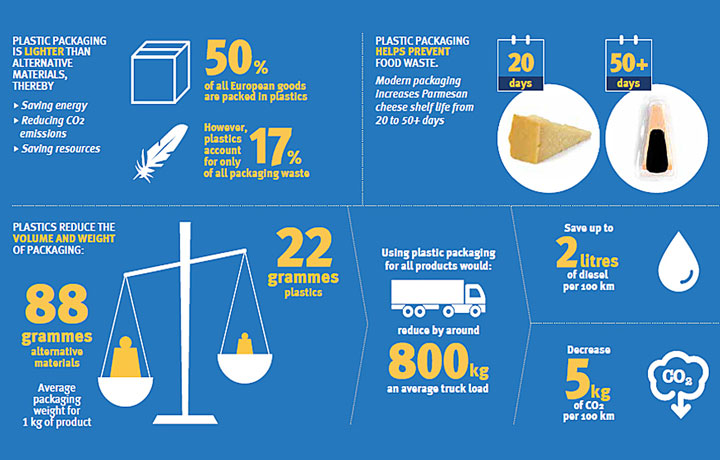
As an example, 85% of the greenhouse gases from production and consumption of cheese are derived from making the cheese itself. But only 3% is from the plastic packaging used to extend the product life of cheese for shipping and storage, which minimizes food wastage and hence greenhouse gas emissions when compared to alternatives.
For shipping, plastic packaging can be less than 20% of the weight of alternatives such as metal and glass. That saves 2 litres of diesel for every 100 km that food has to be transported. And although paper and cardboard packaging is also light, the carbon footprint to produce an equivalent package is three times that of plastic.
It is these benefits that have led to the dominance of plastics in our daily lives, a miracle of modern technology - but the use of plastics has grown faster than the systems which are required to manage them after one-time use.
The Circular Economy - Promise and Pitfalls
The circular usage of plastics (or Circular Economy) is an exciting vision, meaning that we reduce the wastage of natural resources by re-using plastic products as much as possible and then at the end of their life they are either recycled or their energy or raw material value is recovered. This plastics life cycle approach is described by the words: Reduce – Reuse – Recycle – Recover.
The required infrastructure and consumer behavior for segregation, collection and recycle/recover are operational in the most developed economies, for example Northern Europe. However in Asia, we miss the basics of collection and containment of waste. And mechanical recycling is difficult to achieve and will only ever be a partial solution. Feedstock recycling technologies to recover the raw materials for re-use are being developed, but not yet commercially proven. Hence circular economy is not a quick fix and even risks distracting focus from our most urgent issue, which is to solve the marine litter issue.
Society is not going to be tolerant of a slow response, and if we do not address this quickly, governments and brand owners will elect to take action in response to consumer pressure, adopting alternate materials or banning plastics in certain applications – regardless of the potential for negative impact on climate change.
Marine Litter
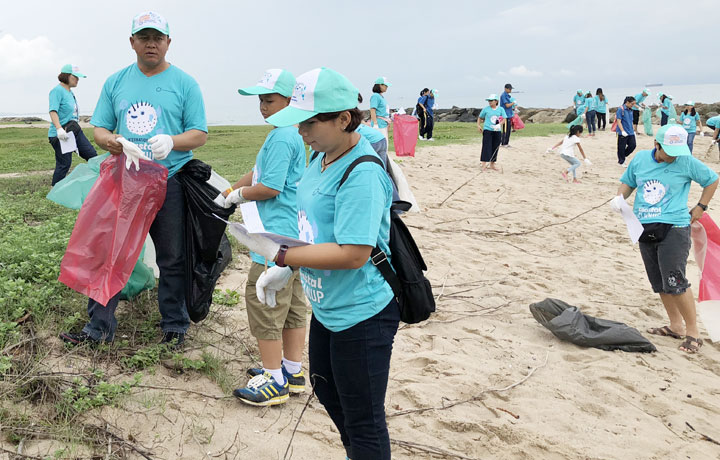
80% of global marine litter is estimated to come from Asia, and Thailand is one of the top 10 culprits. Marine litter is primarily an issue of consumer waste collection and containment. Every household and every public place needs to have facilities for storage and collection of waste. Also, public awareness programs to change behaviours are important for success. Then once collected, what do we do with the waste?
Plastics such as polypropylene has a calorific value similar to oil and gas and 50% higher than coal. Hence given the time required to develop solutions for mechanical or feedstock recycling, energy recovery to treat dry consumer waste is a good solution, reducing dependence on burning coal, oil and gas and better than landfill which can only be a temporary solution.
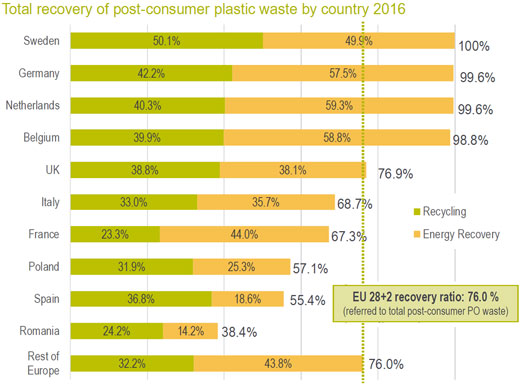
Energy recovery is fully proven in Europe, US, Singapore and Japan, with lower carbon footprint and lower emissions of noxious gases than conventional energy generation from fossil fuels. Some Northern European countries collect 99% of their plastic waste, of which as much as 60% is sent to energy recovery plants, and generating 10% of their national energy requirement. Recommended reading: McKinsey report: Saving the ocean from plastic waste.
What are we doing at HMC?
Customers ask us about recyclable products. Our answer is that polypropylene is already 100% recyclable but the problem is how to collect and contain concentrated clean streams of a single plastic to be able to recycle.
Customers also ask us about bio-based and bio-degradability. Applications for bio-based products are possible, but without subsidies will be more expensive and require large amounts of agricultural land to replace even 10% of today’s plastic volumes. And bio-degradable products can be great to collect and compost wet waste, but degradation of litter in a marine environment can still be slow.
Improvements to the sustainability issue will come from the cumulative impact of many different approaches, but we remain convinced that the biggest contribution will be from applying “Reduce, Reuse, Recycle and Recover” – and managing waste properly to recover its intrinsic value.
So what is HMC doing? Our main focus is in three parts:
- Supporting industry to understand what makes environmental sense in order to rapidly resolve the marine litter issue. We are participating in the Private Public Partnership under the Federation of Thai Industry to help develop waste collection and containment infrastructures for selected areas.
- Seeking to support customers with specific projects for mechanical recycling.
- Working to educate our employees, local community, students etc. on understanding the environmental life-cycle benefits of plastics, their responsible use and disposal.
Alone one company cannot address all the issues, but with a focus on the priority of marine litter first – and collaboration with all stakeholders - we believe the problem of marine litter can and will be solved. Thereafter we can work on maximizing the capture of the value of waste, further progressing towards the vision of circular usage.
Article link – Plastics Institute of Thailand